


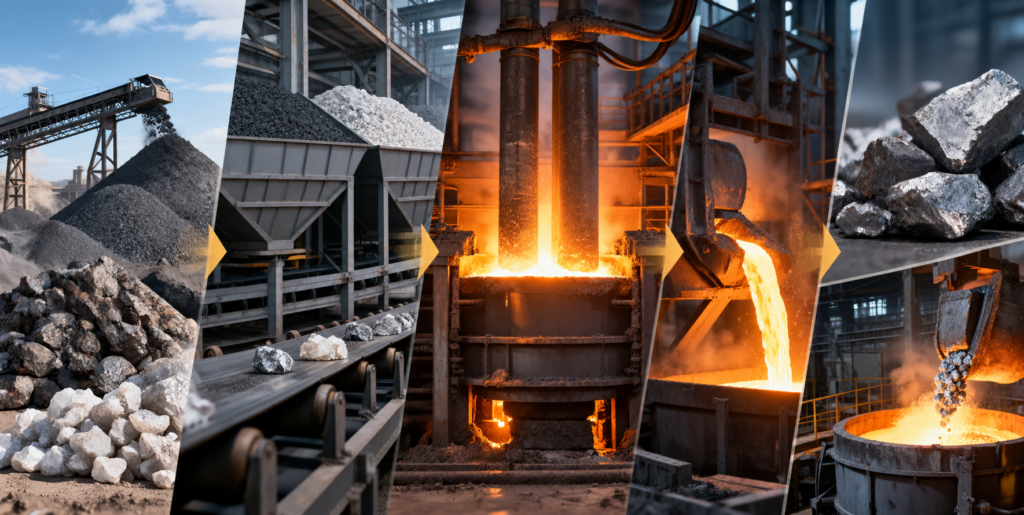
Ferro alloys are essential materials in modern steelmaking. Silico Manganese is one of the most important manganese-based ferro alloys, combining manganese and silicon to support alloying and deoxidisation in steel production.
Silico Manganese, commonly known as SiMn, is an important ferro alloy used in modern steelmaking. It combines manganese and silicon with controlled levels of carbon and other elements, helping steelmakers achieve the required chemical composition and performance in finished steel.
Silico Manganese is particularly important because it can provide both manganese and silicon in a single alloying addition. This makes it a widely used material in the production of carbon, structural and other alloyed steels.
The composition of SiMn is controlled according to the required grade. In addition to manganese and silicon, carbon, phosphorus and sulphur are important parameters when determining the suitability of an alloy for a particular steelmaking application.
As an illustration, a current Indian market specification for HC SiMn 60-14 lists approximately 60% manganese, 14% silicon, 2% carbon, 0.30% phosphorus and 0.04% sulphur. Actual specifications can vary between grades and suppliers.
Controlling these elements is important because steelmakers require predictable alloy chemistry to achieve consistency in the final product.
One of the principal functions of SiMn is deoxidisation. During steel production, oxygen dissolved in molten steel can adversely affect the quality of the final product. Silicon in SiMn reacts with oxygen, helping reduce dissolved oxygen.
Manganese also performs an important alloying function. It contributes to the strength and hardness of steel and helps address the effects of sulphur during steelmaking.
The combined addition of manganese and silicon makes SiMn particularly useful for large-scale steel production, where efficient alloying and controlled chemistry are essential.
Silico Manganese is used across a range of steelmaking applications, including:
Its role becomes particularly important where manufacturers need to achieve specific mechanical properties while maintaining controlled steel chemistry.
India has a significant position in the global manganese-alloy industry. According to BigMint’s latest analysis presented in 2026, India’s Silico Manganese production increased from approximately 2.8 million tonnes in 2024 to 3.2 million tonnes in 2025. Indian SiMn exports also increased 13% year-on-year to approximately 1.25 million tonnes in 2025, making India the leading exporter of manganese alloys during the year.
The broader Indian ferro-alloy industry has an installed capacity of approximately 5.15 million tonnes, according to the Indian Ferro Alloys Producers’ Association (IFAPA).
These figures reflect the important role of manganese alloys within India’s steel and ferro-alloy value chain.
Giridhan Metal’s integrated steel manufacturing operations at Jamuria, West Bengal, include a dedicated ferro-alloy portfolio focused on Ferro Manganese and Silico Manganese. The company’s product range includes HC SiMn, MC SiMn and LC SiMn, manufactured to defined chemical specifications for steelmaking requirements.
Silico Manganese may be used in relatively small quantities compared with the total volume of steel produced, but its contribution to steel chemistry is significant. By combining manganese and silicon in one ferro alloy, SiMn helps steelmakers achieve controlled composition and the properties required for modern steel applications.