

Steel is one of the most important materials supporting modern infrastructure, from buildings, bridges and railways to automobiles, power plants and industrial equipment. Producing steel, however, involves a complex chain of processes. An Integrated Steel Plant (ISP) brings several of these processes together within one interconnected manufacturing ecosystem.
In simple terms, an integrated steel plant converts iron-bearing raw materials into finished steel products through a connected sequence of ironmaking, steelmaking, casting and rolling processes.
A conventional integrated steel plant generally follows the process:
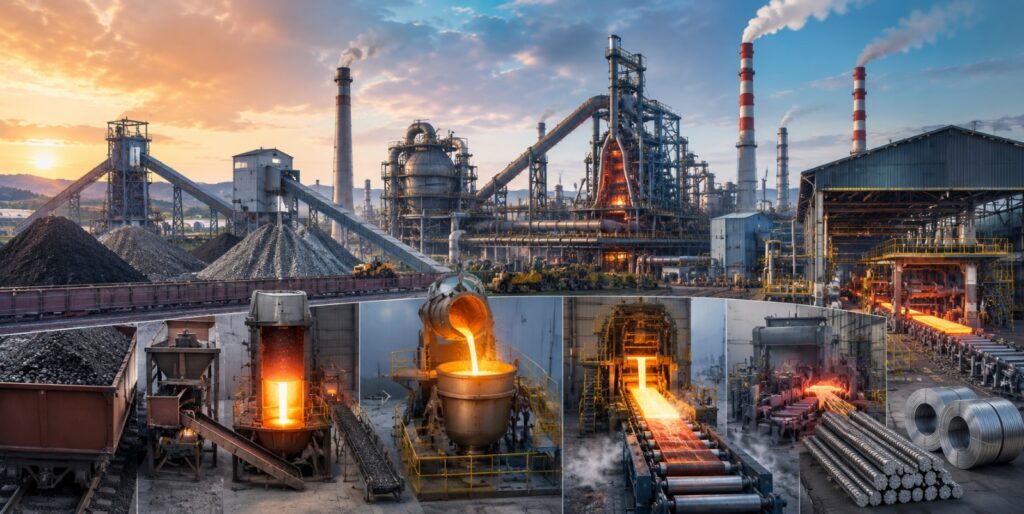
Raw Materials → Ironmaking → Steelmaking → Secondary Metallurgy → Continuous Casting → Rolling → Finished Products
The process starts with raw materials such as iron ore, coal, limestone and dolomite. Depending on the plant configuration, iron ore fines may undergo sintering or pelletisation to improve their suitability for ironmaking.
In the traditional route, coking coal is converted into coke by heating it in the absence of oxygen. Coke acts as both a fuel and reducing agent inside the blast furnace.
The blast furnace is the core unit of conventional ironmaking. Iron ore, coke and fluxes are charged from the top, while hot air is injected through tuyeres near the bottom. Temperatures can reach around 2,000°C in the combustion zone, enabling chemical reactions that reduce iron oxides to metallic iron.
The resulting molten iron, known as hot metal, typically contains around 4–5% carbon and is transferred to the steelmaking shop.
Steelmaking and Secondary Metallurgy
Hot metal is converted into crude steel, traditionally through a Basic Oxygen Furnace (BOF). High-purity oxygen is blown into the molten metal to reduce excess carbon and impurities such as silicon, manganese and phosphorus.
The molten steel may then undergo secondary metallurgy using processes such as Ladle Furnace (LF), argon stirring or vacuum treatment. These processes allow precise control of temperature, chemical composition and steel cleanliness, which are essential for producing specific grades and mechanical properties.
The refined molten steel is transferred to a Continuous Casting Machine (CCM), where it is continuously solidified into semi-finished products such as billets, blooms or slabs.
For long products such as TMT bars and wire rods, billets are commonly used as the feedstock for rolling. Continuous casting improves productivity, yield and consistency compared with conventional ingot casting.
Semi-finished steel is reheated and passed through a series of rolling stands to produce products such as TMT bars, wire rods, structural sections, plates and sheets, depending on the plant configuration.
In TMT bar production, controlled water cooling after rolling creates a hardened outer layer while retaining a comparatively ductile core. This thermo-mechanical treatment provides the required balance of strength, ductility and toughness for reinforced concrete applications.
The key advantage of an integrated steel plant is the efficient coordination of materials, energy and production processes.
Process gases such as coke oven gas, blast furnace gas and basic oxygen furnace gas can be recovered and reused for heating or power generation. Waste heat can also be recovered, while slag and other by-products can be processed for productive applications.
A large integrated facility may also include a captive power plant, oxygen plant, water-treatment facilities, lime and dolomite plants, laboratories, material-handling systems and waste-management infrastructure.
This integration improves resource utilisation, operational efficiency and process control while reducing dependence on external inputs.
The traditional blast furnace–BOF route is not the only model for modern integrated steel production. Facilities can also integrate Direct Reduced Iron (DRI), Electric Arc Furnace (EAF), continuous casting and rolling.
In the DRI-EAF route, iron ore is reduced in the solid state to produce Direct Reduced Iron, which is subsequently melted in an electric arc furnace. When combined with renewable electricity and low-carbon hydrogen, this route offers significant potential for reducing the carbon intensity of steel production.
India’s steel industry is undergoing an important technological transition. The government has introduced a Green Steel Taxonomy, under which steel with emissions intensity below 2.2 tonnes of CO₂ equivalent per tonne of finished steel can qualify as green steel. Higher ratings are awarded to progressively lower-emission steel, with the five-star category applying below 1.6 tCO₂e per tonne of finished steel.
The sector is increasingly focusing on energy efficiency, renewable power, hydrogen-based steelmaking, increased scrap utilisation, waste-heat recovery and other decarbonisation technologies.
At the same time, investments in new and expanded integrated steel plants are supporting India’s growing demand from infrastructure, construction and manufacturing.
The integrated steel plant of the future will be increasingly digital, automated, energy-efficient and sustainable. Artificial intelligence, predictive maintenance, real-time process monitoring, renewable energy, hydrogen-based ironmaking and advanced water recycling are expected to become increasingly important.
Ultimately, an integrated steel plant is more than a steel manufacturing facility. It is a connected industrial ecosystem that transforms raw materials into high-quality steel through a carefully controlled sequence of processes.
As India’s steel demand grows, the focus will increasingly shift from simply producing more steel to producing stronger, smarter and more sustainable steel.