


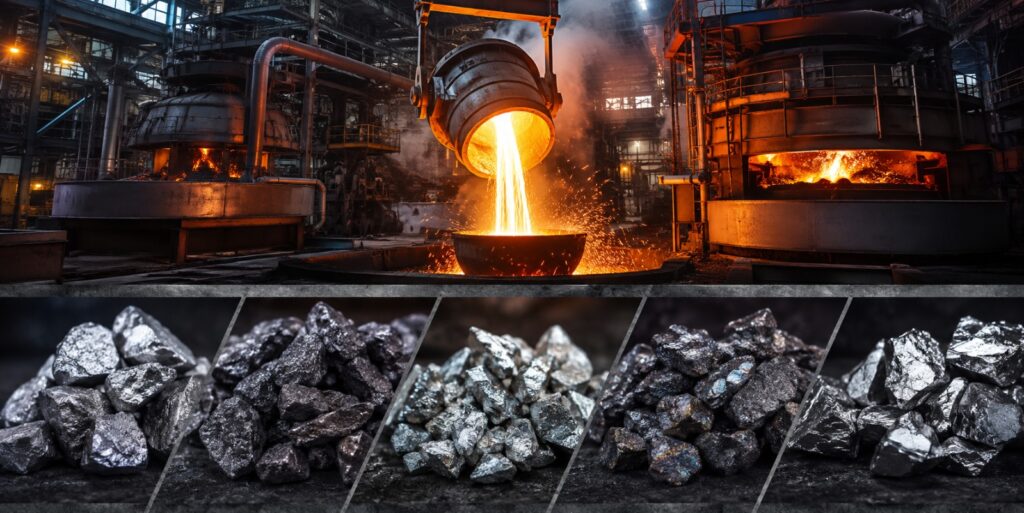
Ferro alloys are essential materials in modern steelmaking. Although they are used in relatively small quantities, they play an important role in controlling the chemistry and performance of steel. By introducing elements such as manganese, silicon, chromium and other alloying elements into molten steel, ferro alloys help manufacturers produce grades with specific characteristics for construction, automotive, infrastructure, engineering and specialised applications.
The importance of ferro alloys is closely linked to India’s expanding steel industry. According to the Ministry of Steel’s latest Annual Report 2025–26, India’s crude steel production reached 124.55 million tonnes during April–December 2025, registering an increase of 11.4% over the corresponding period. Finished steel production during the same period stood at 118.70 million tonnes, up 10.5%. India’s crude steel capacity had also reached 218.45 million tonnes per annum by December 2025.
What Are Ferro Alloys?
Ferro alloys are metallic alloys containing iron along with one or more other elements. They are primarily added to molten steel as alloying agents and deoxidisers. Depending on their composition and application, ferro alloys are broadly classified into bulk ferro alloys and noble ferro alloys.
India has a substantial ferro-alloy manufacturing ecosystem. Industry data cited in the 2024–25 annual report of Sandur Manganese & Iron Ores Limited places India’s total installed ferro-alloy capacity at approximately 5.15 million tonnes per annum, including around 5.10 million tonnes of bulk ferro alloys and 50,000 tonnes of noble ferro alloys. Manganese alloys account for approximately 3.16 million tonnes of this capacity.
Major Types of Ferro Alloys and Their Uses
Ferro Manganese is one of the most widely used ferro alloys in steel production. Manganese contributes to the strength, hardness and toughness of steel and also helps address the effects of sulphur during the steelmaking process.
Ferro Manganese is available in different grades depending on the required chemical composition. These include High Carbon Ferro Manganese (HC FeMn), Low Phosphorus High Carbon Ferro Manganese (LP HC FeMn) and Medium Carbon Ferro Manganese (MC FeMn).
These grades are used in steelmaking applications where controlled manganese and carbon chemistry is required.
Silico Manganese combines manganese and silicon and serves as both an alloying agent and deoxidiser. Silicon assists in removing oxygen from molten steel, while manganese contributes to the required mechanical properties of the finished steel.
Silico Manganese is widely used in the production of carbon steel, construction steel, structural steel and other alloyed steel products.
Giridhan Metal’s product portfolio includes High Carbon Silico Manganese (HC SiMn), Medium Carbon Silico Manganese (MC SiMn) and Low Carbon Silico Manganese (LC SiMn). Depending on the grade, the company’s SiMn specifications include manganese in the 40–65% range and silicon in the 10–15% range.
Ferro Silicon is primarily used as a deoxidising and alloying agent in steelmaking. Silicon can improve the strength of steel and is also important in the production of certain electrical and magnetic steels.
Ferro Silicon is also used in cast iron and foundry applications. However, it is important to distinguish between the wider ferro-alloy industry and the specific products offered by individual manufacturers.
Ferro Chrome is an important source of chromium for steel production and is particularly associated with the manufacture of stainless and alloy steels. Chromium contributes to corrosion resistance, hardness and other performance characteristics.
Ferro Chrome is therefore an important part of India’s broader ferro-alloy industry, although its production should not automatically be attributed to every ferro-alloy manufacturer.
Noble ferro alloys include materials such as Ferro Vanadium, Ferro Molybdenum, Ferro Titanium, Ferro Niobium and Ferro Tungsten. They are generally used in smaller quantities than bulk ferro alloys but are important for specialised and high-performance steel grades.
Their applications can include automotive, aerospace, power generation, engineering and other specialised industries, depending on the alloy and the properties required.
Why Ferro Alloys Matter to India’s Steel Industry
The growth of ferro alloys is closely connected with the expansion and diversification of steel production. India’s crude steel capacity increased to 218.45 million tonnes per annum by December 2025, while production during April–December 2025 reached 124.55 million tonnes.
As steelmakers produce increasingly specialised grades, consistent alloy chemistry becomes more important. Controlled levels of manganese, silicon, carbon, phosphorus and sulphur can influence the quality and performance of the final steel product.
India is also an important participant in the global ferro-alloy market. According to the 2024–25 annual report of Sandur Manganese & Iron Ores, India is a significant producer and exporter of ferro alloys, with approximately 25–30% of production typically exported.
Ferro Alloys at Giridhan Metal
For an integrated steel manufacturer such as Giridhan Metal, ferro alloys form an important part of the steelmaking ecosystem. At its integrated steel manufacturing facility in Jamuria, West Bengal, Giridhan Metal’s ferro-alloy portfolio focuses on Ferro Manganese and Silico Manganese.
Its product range includes HC, MC and LC variants of Silico Manganese and different grades of Ferro Manganese, allowing customers to select products according to their required chemical composition and steelmaking application.
With controlled chemistry and application-specific grades, ferro alloys help steelmakers achieve greater consistency in their production processes.
The Future of Ferro Alloys in India
As India’s infrastructure, construction, automotive and engineering sectors continue to support steel demand, the requirement for specialised and performance-oriented steel is expected to remain significant.
This makes consistent ferro-alloy quality, precise chemical composition and reliable manufacturing processes increasingly important.
Ferro alloys may be added to steel in relatively small quantities, but their influence is significant. They help steelmakers control chemistry and develop the properties required for different applications. As India’s steel industry continues to expand, ferro alloys will remain a critical link in the country’s steel value chain.